
















Weekend rides rarely stay on smooth pavement from start to finish.
The route may begin on an ordinary road outside town, but as you continue toward a campground, lake, or wooded area, the surface can quickly change to gravel, ruts, and rolling terrain. The farther you ride, the less the experience depends on top speed alone. Battery capacity, suspension comfort, and the bike’s ability to carry both the rider and outdoor gear become just as important.
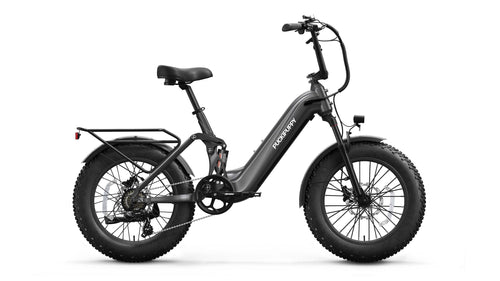
The Puckipuppy Labrador Pro and Velotric Nomad 2X are both 750W full-suspension fat-tire e-bikes. Each comes with 26” x 4.0” fat tires, hydraulic disc brakes, a Shimano 8-speed drivetrain, and both torque and cadence sensors. As a result, they are designed for many of the same basic riding conditions.
However, the two bikes take different approaches to equipment and value.
At a noticeably lower price, the Labrador Pro provides a larger 48V 20Ah battery, comparable motor performance, and a complete set of outdoor-focused features. The Nomad 2X goes further in maximum payload, suspension specifications, front braking hardware, and frame options.
The real question is not which bike is better in every category. It is which combination of features better matches your routes, body size, gear load, and budget.
What Are the Key Differences Between the Labrador Pro and Nomad 2X?
|
Specification |
Puckipuppy Labrador Pro |
Velotric Nomad 2X |
|
Bike Type |
Full-suspension fat-tire outdoor e-bike |
Full-suspension fat-tire outdoor e-bike |
|
List Price |
$1,699.99 |
$2,399 |
|
Motor |
750W rated, 1,350W peak |
750W rated, 1,400W peak, 105 Nm |
|
Maximum Pedal-Assist Speed |
28 mph |
Adjustable up to 28 mph |
|
Default Throttle Speed |
20 mph |
20 mph |
|
Battery |
48V 20Ah, approximately 960Wh |
48V 16.7Ah, 801.6Wh |
|
Advertised Range |
40–80 miles |
Up to 75 miles with pedal assist |
|
Charger |
48V 2A |
48V 3A |
|
Front Fork |
Adjustable suspension fork with more than 110mm of travel |
Adjustable 120mm air suspension fork |
|
Tires |
26" × 4" fat tires |
26" × 4" fat tires |
|
Brakes |
Hydraulic disc brakes with 180mm front and rear rotors |
Hydraulic disc brakes with a 203mm front and 180mm rear rotor |
|
Drivetrain |
Shimano 8-speed |
Shimano 8-speed |
|
Sensor System |
Torque and cadence sensors |
Torque and cadence sensors |
|
Bike Weight |
85.7 lbs |
80 lbs |
|
Maximum Payload |
400 lbs |
560 lbs |
|
Recommended Rider Height |
5'4"–6'6" |
Step-Through: 4'11"–5'10"; High-Step: 5'10"–6'5" |
|
Bike Water Resistance |
IPX6 |
IPX6 |
|
Battery Water Resistance |
IPX7 |
IPX7 |
|
Safety Certifications |
UL 2849 and UL 2271 |
UL 2849 and UL 2271 |
The two bikes are very similar in motor rating, top speed, tire size, sensor system, drivetrain, and core safety certifications.

Is There a Noticeable Performance Difference Between the Two 750W Motors?
The Labrador Pro uses a 750W rated motor with 1.350W of peak output. The Nomad 2X also uses a 750W rated motor, with peak output reaching 1.400W. Their rated power is identical, their peak output differs by only 50W, and both bikes can reach a maximum pedal-assist speed of 28 mph.
On a fat-tire e-bike, a 750W motor does more than increase speed. It also needs to overcome the added rolling resistance of wider tires while assisting the combined weight of the bike, rider, and gear.
However, the 50W difference between 1.350W and 1.400W is not enough by itself to prove that one bike will accelerate or climb noticeably better in real-world conditions. Actual performance also depends on controller tuning, total load, grade, gearing, tire pressure, and battery charge.
How Much Difference Is There Between a 960Wh and an 801.6Wh Battery?
The Labrador Pro uses a 48V 20Ah battery with approximately 960Wh of energy. The Nomad 2X uses a 48V 16.7Ah battery rated at 801.6Wh.
Based on energy capacity, the Labrador Pro stores about 158Wh more, which is close to a 20% increase.
Watt-hours measure the total amount of energy a battery can store. A larger battery does not guarantee a fixed number of additional miles in every riding condition, but it can provide more reserve capacity in situations that consume more power.
This difference is most likely to matter in the following situations.
Longer Round-Trip Routes
Campgrounds, wooded areas, and lakeside routes do not always offer convenient charging. A larger battery can leave more energy available for the return trip, unexpected detours, or last-minute route changes.
Repeated Climbs
The motor operates under a heavier load while climbing, which generally uses more energy than riding on level ground. A larger battery can reduce the effect that repeated hills have on the total trip.
Higher Pedal-Assist Levels
Riders are more likely to increase assist when facing a headwind, carrying gear, or becoming tired. Higher assist levels consume energy more quickly, making the additional battery capacity more useful.
Cold-Weather Riding
Lower temperatures can reduce the usable energy available from a lithium-ion battery. During early-morning rides, fall and winter conditions, or higher-elevation trips, a larger battery can provide more range reserve.
The Labrador Pro has an advertised range of 40 to 80 miles, while the Nomad 2X offers up to 75 miles with pedal assist. Because the two brands may use different testing conditions, the difference between 80 and 75 miles should not be treated as a direct five-mile comparison under identical conditions.

How Do the 2A and 3A Chargers Fit Different Riding Schedules?
The Labrador Pro comes with a 48V 2A charger, while the Nomad 2X comes with a 48V 3A charger.
When the battery management system allows it, higher charging current generally means that the same amount of energy can be added in less time.
The Nomad 2X’s 3A charger is more convenient when charging time between rides is limited. The Labrador Pro stores more total energy but uses a 2A charger, so a full recharge may require a longer charging window. In short, the Labrador Pro prioritizes stored energy, while the Nomad 2X prioritizes faster energy replenishment.
However, charger amperage alone does not determine the exact charging time. Battery capacity, BMS limits, temperature, and the reduced charging rate near full capacity can also affect how long each battery takes to recharge.
How Do the Full-Suspension Systems Compare?
Both the Labrador Pro and Nomad 2X use front and rear suspension, but the suspension specifications published by the two brands are not completely equal.
The Labrador Pro includes an adjustable front fork with more than 110mm of travel and a rear suspension system. Its focus is to provide a complete full-suspension setup at a lower price.
The Nomad 2X uses an adjustable 120mm air suspension fork and a DNM 38mm rear air shock with up to 80mm of rear-wheel travel. Air suspension can be adjusted to suit rider weight and bike load, while also offering more defined control over rebound settings.
As a result, the Nomad 2X is better suited to riders who want to tune the suspension around body weight, gear load, and trail conditions. The Labrador Pro is better suited to riders who want the comfort of front and rear suspension without needing to make frequent, detailed adjustments.
What Does a 203mm Front Brake Rotor Add Under Heavy Loads and on Long Descents?
Both bikes use hydraulic disc brakes.
The Labrador Pro uses 180mm front and rear rotors, while the Nomad 2X uses a 203mm front rotor and a 180mm rear rotor.
The larger front rotor mainly provides two benefits.
Greater Braking Leverage
Because the brake caliper applies force farther from the wheel hub, a larger rotor can produce more braking leverage with less hand pressure. This can be especially useful when the bike is carrying a heavier load.
More Surface Area for Heat Management
During long descents or repeated braking, the rotor continues to build heat. A 203mm rotor has more surface area, which can help release heat and reduce excessive heat buildup during sustained braking.
The larger front rotor on the Nomad 2X matches its 560-pound maximum payload and gives it a hardware advantage in high-load situations and on longer descents.
The Labrador Pro’s 180mm hydraulic disc brakes match its 400-pound maximum payload and general mixed-terrain positioning. For regular gravel roads, campground routes, and weekend riding, the hydraulic system still provides direct braking feel and a solid level of control.

How Do 400-Pound and 560-Pound Payload Ratings Affect Real-World Use?
The Labrador Pro has a maximum payload of 400 pounds, while the Nomad 2X is rated for 560 pounds, a difference of 160 pounds.
Maximum payload includes everything the bike is carrying, such as:
- The rider;
- A backpack and clothing;
- Water, food, and tools;
- Accessories installed on the bike;
- Camping, fishing, or other outdoor equipment.
A 400-pound payload is enough for most adult riders and regular outdoor gear. For example, a 250-pound rider would theoretically have 150 pounds of total payload capacity remaining, although a reasonable safety margin should still be maintained in actual use.
The Nomad 2X’s 560-pound rating is better suited to riders who:
- Have a higher body weight;
- Regularly carry a large amount of gear;
- May bring the total load close to or above 400 pounds;
- Want more structural capacity in reserve.
Whether that extra capacity is worth paying for depends on the actual load. If the rider and gear remain well below 400 pounds, the higher payload limit will not automatically improve speed, range, or comfort.
A larger payload number is not always better by itself. It needs to match the bike’s real use.
Which Bike Is Easier to Move, Load, and Store?
The Labrador Pro weighs 85.7 pounds, while the Nomad 2X weighs 80 pounds.
When the motor is providing assistance, the difference may not feel especially large. However, the 5.7-pound difference can be more noticeable when:
- Lifting the bike onto a vehicle rack;
- Carrying it over a threshold or up steps;
- Repositioning it in a tight garage;
- Pushing it after the battery is depleted;
- Moving it out of sand or mud.
The Nomad 2X has an advantage in overall bike weight, but both bikes weigh 80 pounds or more and should not be considered lightweight e-bikes.
Which Riders Are Better Suited to High-Step and Step-Through Frames?
The Labrador Pro uses a standard high-step frame and is recommended for riders from 5'4" to 6'6".
The Nomad 2X is available in two frame styles. The Step-Through version is designed for riders from 4'11" to 5'10", while the High-Step version fits riders from 5'10" to 6'5".
A step-through frame reduces the height a rider must lift a leg over the top tube. It may be a better fit for:
- Shorter riders;
- Riders wearing heavier outdoor clothing;
- Riders who stop frequently;
- Anyone who prioritizes easier mounting and dismounting;
- Riders with limited flexibility or range of motion in the legs.
A high-step frame is closer to a traditional bicycle design and may appeal to riders who are used to a standard riding position and prefer the appearance of a conventional frame.
The Nomad 2X offers more frame choices and is better able to accommodate riders under 5'4". This is a clear advantage in rider fit.
The Labrador Pro uses one standard frame to cover a broad recommended height range from 5'4" to 6'6". It is better suited to riders within that range who prefer a high-step design.
Which Riders Are Better Suited to the Labrador Pro and Nomad 2X?
The Labrador Pro Is Better Suited to Riders Who:
- Prioritize battery capacity and return-trip reserve;
- Keep the combined rider-and-gear load below 400 pounds;
- Fit the recommended 5'4"–6'6" height range and prefer a high-step frame;
- Want full suspension and similar core power at a lower price.
The Labrador Pro’s value is not limited to its lower price. Even at a noticeably lower cost, it still provides a similar power level to the Nomad 2X while offering a larger battery.
Labrador Pro Ebike
The Nomad 2X Is Better Suited to Riders Who:
- Need payload capacity above 400 pounds;
- Regularly ride rough surfaces or carry heavier loads;
- Want adjustable front and rear air suspension;
- Need a step-through option or fit outside the Labrador Pro’s height range.
The main advantage of the Nomad 2X is not significantly higher peak motor output. Its advantages are centered on payload capacity, suspension adjustability, and rider fit.
Labrador Pro or Nomad 2X: How Should You Choose?
There is no single answer that works for every rider.
Both the Puckipuppy Labrador Pro and Velotric Nomad 2X can extend a ride beyond pavement and onto gravel roads, campground roads, and general outdoor routes. The deciding factor is not which bike has the longest list of specifications, but which combination of features better fits the way the bike will actually be used.
The Nomad 2X has stronger specifications in maximum payload, air suspension, front brake rotor size, overall bike weight, and frame selection. For riders carrying heavier loads, regularly riding over repeated rough terrain, or specifically needing a step-through frame, these upgrades can provide better support, more adjustability, and greater convenience.
The Labrador Pro has a regular list price approximately $700 lower while offering the same 750W rated motor output, similar peak power, the same maximum pedal-assist speed, the same tire size, and the same core drivetrain and safety certifications. It also has a battery with approximately 20% more capacity, providing additional energy reserve for longer round trips, repeated climbs, and higher-assist riding.
The final decision should come back to four questions: What surfaces do you ride most often? How much total weight do you need to carry? Do you need a step-through frame? How much more are you willing to spend for suspension and payload upgrades?
The right bike is not necessarily the one with the most specifications. It is the one whose main advantages will actually be used on every ride.