
















The best electric bikes for women are not defined by a women-specific label. A better way to choose is to look at how well the bike fits the rider, how manageable it feels at low speeds, and whether its weight, frame style, and equipment make sense for the rides it will actually be used for.
A rider commuting on smooth city streets may benefit more from a lighter bike than from fat tires or full suspension. Someone dealing with frequent stops may care more about step-through access, while rough pavement and weekend trails can justify a heavier, more capable setup.
What Should Women Look for in an E-Bike?
Start with the riding problem first, then look at the specification that solves it.
|
Rider Need |
What to Look For |
Why It Matters |
|
Shorter rider |
Lower standover height, suitable saddle range, manageable reach |
Makes the bike easier to fit and control |
|
Frequent stops |
Step-through or low-step frame |
Makes getting on and off easier |
|
Apartment living |
Lower bike weight |
Helps with carrying, storage, and tight spaces |
|
Daily commuting |
Comfortable fit, practical range, rack and lights |
Supports everyday use |
|
Rough roads |
Wider tires and/or suspension |
Better suited to potholes and uneven pavement |
|
Weekend trails |
Suspension, suitable tires, stable geometry |
Adds capability on gravel and dirt |
Fit Comes First: Height, Frame Style, and Riding Position
Height is useful for narrowing down an e-bike, but it should not be the final sizing decision. Inseam, standover height, saddle adjustment, and reach determine how the bike actually feels once the rider starts, stops, and steers.
Shorter riders—especially those near or below 5'3"—should pay close attention to minimum saddle height and standover height. A bike may technically fit according to a height chart but still feel oversized if the rider has to lean it sharply to one side every time she stops.
Around 5'3" to 5'6", the range of adult e-bikes becomes wider, but reach still matters. The brake levers should be easy to reach without stretching, and the rider should be able to control the bike at a stop without feeling overwhelmed by the frame.
From roughly 5'7" to 5'10", there is generally more freedom to choose around riding style. Someone who wants relaxed city commuting may prefer a more upright cockpit, while a rider focused on fitness or longer recreational rides may prefer a more forward position. Taller riders should check that the saddle rises high enough for comfortable leg extension and that the cockpit does not feel cramped.
Body proportions matter within every height range. Two riders who are both 5'7" can have different inseams, torso lengths, and arm lengths, so the same frame may fit them differently.

Frame style should be considered as part of that fit. A step through electric bike for women is particularly practical when getting on and off happens frequently. Commuters dealing with traffic lights, errands, rear cargo, or limited hip mobility may notice the lower frame every day. A rider who mounts once and stays on the bike for a long recreational ride may care much less about it.
Step-over bikes are still a valid choice for women who are comfortable clearing the top tube. For fitness riding, longer routes, or sportier riding, geometry and riding position may matter more than low frame access.
Reach provides another useful check. Locked elbows, tense shoulders, excessive pressure on the hands, or difficulty reaching the brake levers can all indicate that the cockpit is too long. Lowering the saddle will not fix excessive reach.
The bike should fit naturally before motor power, range, or other performance specifications enter the decision.
How Weight, Brakes, and Pedal Assist Affect Control
E-bike weight is easy to overlook during a powered ride. It becomes much more obvious when the bike has to be pushed through a doorway, turned around in a garage, lifted onto a vehicle rack, or carried upstairs.
As a practical reference rather than a formal industry classification, bikes under roughly 50 pounds are easier to consider when carrying and storage are major concerns. Bikes in the 50-to-70-pound range often balance commuter comfort, battery capacity, and manageable weight. Once a bike moves above 70 pounds, fat tires, full suspension, larger batteries, or all-terrain equipment are often part of the reason.
The question is not simply whether the rider can pedal the bike. It is whether she can still move and control it comfortably when the motor is off.
Braking matters for the same reason. A heavier bike carrying a rider and cargo requires more control during stops than a lightweight city bike. The brake levers should be easy to reach, and braking should build progressively rather than feeling difficult to modulate.

Pedal-assist behavior also affects confidence at low speeds. Maximum wattage matters less when pulling away from a traffic light or making a tight turn than how predictably the motor responds.
Cadence sensors generally activate assistance based on pedal movement, while torque sensors respond to how hard the rider is pressing on the pedals. Riders who prefer assistance that changes more closely with their effort may prefer the feel of a torque-based system.
For everyday control, predictable response is usually more useful than simply having the biggest motor.
Match the Bike to the Commute and the Road
Once fit and basic control are right, the road surface should decide how much additional equipment is worth carrying.
For mostly smooth city streets and paved bike paths, moderate-width tires, lower bike weight, comfortable reach, and useful commuter equipment are usually enough. Full suspension or very wide tires may add little if the route rarely includes rough surfaces.
Stop-and-go commuting puts more emphasis on easy frame access, predictable assistance, braking, and cargo capacity. A bike that is comfortable through repeated intersections and short errands can be more practical than a heavier all-terrain model with features that never get used.
Rough pavement, potholes, gravel connectors, and park paths change that balance. More tire volume can help the bike feel less harsh over uneven surfaces, while suspension becomes more worthwhile as those surfaces get rougher. The tradeoff is additional weight.

For riders who commute during the week and regularly ride trails on weekends, that tradeoff may be justified. Trail-capable tires, suspension, and stable geometry allow one bike to cover a broader range of terrain, but there is little reason to carry that equipment if the bike rarely leaves pavement.
Range should be judged just as practically. Start with the normal round-trip distance and leave a reasonable reserve. Hills, assist level, speed, rider weight, cargo, temperature, and stop-and-go riding can all change battery consumption.
A rider traveling 10 or 15 miles per day does not necessarily need the largest battery available, especially if the extra capacity makes the bike noticeably heavier to store or carry.
Commuter equipment should solve similarly concrete problems. A removable battery is useful when the bike cannot be parked next to an outlet. A rear rack keeps a laptop bag or groceries off the rider's back. Lights support early and evening rides, while fenders help keep road spray off clothing on wet streets.
Storage should be considered before buying, not after. Stairs, elevators, narrow hallways, garage space, and vehicle-rack weight limits can all change which bike is actually practical.
Puckipuppy E-Bikes for Different Riding Needs
Once fit, frame access, and riding conditions are clear, the specifications are easier to compare.
Doberman — For Lightweight City Riding
At 42 lb, the Doberman is the lightest model in this group, making it easier to maneuver, store, or carry than larger fat-tire bikes. Its 700 × 45C tires, hydraulic disc brakes, and torque-and-cadence sensing suit paved streets and daily commuting, while a 45–70-mile range covers many everyday trips.
Its 30.71-inch standover height is worth considering for riders who prefer easier mounting. For a lower-step frame, Poodle may be a better fit.
Doberman
Poodle — For Easy Step-Through Commuting
The Poodle focuses on accessibility and everyday comfort. Its 19.4-inch standover height and 29.13-inch minimum saddle height make mounting easier, while its 63.1-lb weight remains more manageable than the fat-tire models below.
With 27.5 × 2.4-inch tires and 80 mm adjustable front suspension, it adds cushioning for city streets without the bulk of a 4-inch fat-tire setup. It is best suited to riders prioritizing step-through access and daily commuting.
Poodle
Boxer ST — For Gravel and Mixed Surfaces
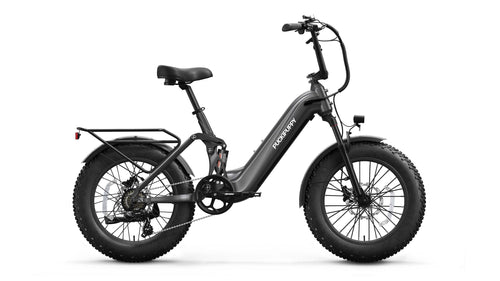
The Boxer ST is better suited to riders who regularly encounter potholes, gravel, and changing surfaces. A low 16.3-inch standover height improves frame access, while 26 × 4-inch tires, 130 mm front suspension, and rear suspension provide more cushioning on uneven terrain.
Its 84.6-lb weight makes it less convenient to carry, but the removable 48V 20Ah battery and 40–80-mile range support longer commutes and recreational rides.
Boxer ST
Labrador Pro ST — For Commuting and Regular Trails
The Labrador Pro ST makes more sense when mixed terrain and trails are a regular part of the ride. It combines a 16.3-inch standover height with 26 × 4-inch fat tires, 130 mm front suspension, rear suspension, and hydraulic disc brakes.
Torque-and-cadence sensing also provides more responsive pedal assistance as effort and terrain change. At 87.1 lb, however, it favors trail capability and ride stability over portability.
The differences come down to riding priorities: Doberman favors low weight, Poodle favors accessible commuting, Boxer ST handles rougher mixed surfaces, and Labrador Pro ST is better suited to riders who regularly combine commuting with trails.
Labrador Pro ST
Which Electric Bike Is Right for You?
Start with fit and manageable weight, then add features only when they solve a real riding need. Step-through access matters more when stops are frequent. Wider tires and suspension become more useful as roads get rougher. Trail-focused equipment makes sense when trails are actually part of the routine.
The best electric bike for women is not the model with the most features. It is the one whose fit, weight, frame style, and riding capability match the way the rider actually uses it.
Explore the Puckipuppy Women’s E-Bikes to compare lightweight, step-through, commuter, and mixed-terrain options and find the setup that fits your ride.