














For most riders, the choice between a 20-inch and 26-inch fat tire e-bike comes down to how and where the bike will be used. A 20-inch setup is usually easier to handle at low speeds, store, and transport, while a 26-inch wheel generally feels more stable and rolls more easily over rough roads, gravel, roots, and other uneven surfaces.
That does not mean one size is automatically better. A 20-inch fat tire e-bike can still handle mixed terrain, and a 26-inch model can work well for everyday riding. Wheel size is only one part of the ride. Tire width, suspension, frame geometry, bike weight, battery, and rider fit also affect comfort and handling.

20-Inch vs 26-Inch Fat Tire E-Bikes
|
Comparison |
20-Inch Fat Tire E-Bike |
26-Inch Fat Tire E-Bike |
|
Handling |
More agile in tight spaces |
More stable at speed |
|
Rough Terrain |
Handles mixed surfaces well |
Rolls over larger bumps and obstacles more easily |
|
Longer Rides |
Better suited to shorter or mixed everyday trips |
Usually feels more settled over longer rides |
|
Storage |
Takes up less space |
Requires more storage room |
|
Transport |
Easier to fit into SUVs or RVs, especially if foldable |
Often requires more cargo space or a bike rack |
|
Typical Use |
Commuting, errands, urban riding |
Gravel, trails, longer outdoor rides |
The real difference becomes clearer once wheel size is matched to the rider’s usual roads, storage needs, and riding distance.
How Does Wheel Size Change the Way an E-Bike Rides?
Wheel size changes how quickly an e-bike responds to steering, how stable it feels once moving, and how easily it carries momentum. The difference is noticeable even when both bikes use wide fat tires.
20-Inch Wheels Feel More Responsive
A 20-inch wheel has a smaller overall diameter, which can make the bike feel quicker to steer and easier to maneuver at lower speeds. This is useful in stop-and-go traffic, parking lots, crowded bike paths, and tighter turns where frequent direction changes are common.
That compact feel can also make a 20-inch fat tire e-bike easier to manage when starting, stopping, or moving the bike by hand.
26-Inch Wheels Feel More Stable
A 26-inch wheel generally feels more settled once the bike is moving. The larger wheel maintains momentum more easily and usually requires fewer steering corrections on open roads, gravel, and longer stretches of trail.
For riders who spend more time covering distance than navigating tight spaces, that added stability can make a 26-inch fat tire e-bike feel more natural and predictable.
The difference is not simply “agile versus stable.” Frame geometry, tire pressure, bike weight, and suspension can all change how either wheel size actually feels on the road.
Which Size Handles Rough Roads and Trails Better?
For rougher roads and trails, 26-inch fat tires generally have the advantage because the larger wheel can roll over potholes, roots, rocks, and ruts more smoothly. The bike tends to lose less momentum when the surface becomes uneven, which can make longer stretches of gravel or trail feel more settled.
A 20-inch fat tire e-bike can still handle mixed terrain well. Its wide tires provide traction and cushioning, while the smaller wheel can feel easier to maneuver through tighter turns or narrow sections. However, larger bumps and deep ruts may feel more noticeable than they would on a comparable 26-inch setup.
In practical terms, 20-inch wheels work well for pavement, neighborhood roads, light gravel, and mixed everyday routes. Riders who regularly encounter rough gravel roads, roots, potholes, or uneven trails will usually benefit more from 26-inch wheels.

Which Is Easier to Store and Transport?
A 20-inch fat tire e-bike is usually easier to store and transport because the smaller wheels reduce the bike’s overall footprint. That can make a noticeable difference for riders with limited garage space, apartments, RVs, or vehicles with smaller cargo areas.
The advantage is even greater when the bike has a folding frame. A foldable 20-inch model may fit more easily into an SUV, RV storage compartment, or other compact space without requiring as much disassembly.
A 26-inch fat tire e-bike generally needs more room. For regular vehicle transport, riders may be more likely to use a bike rack rather than place the entire bike inside the vehicle.
Does Rider Height Decide Between 20-Inch and 26-Inch Wheels?
Rider height can be a useful starting point when choosing between a 20-inch and 26-inch fat tire e-bike. Shorter riders often find a 20-inch setup easier to mount and control, while taller riders may prefer the extra room and full-size feel of a 26-inch bike.
|
Rider Height |
20-Inch Fat Tire E-Bike |
26-Inch Fat Tire E-Bike |
|
Under 5'4" |
Usually easier to mount, stop, and manage |
May feel large unless the frame is designed for shorter riders |
|
5'4"–5'8" |
A good fit for riders who prefer a compact, agile ride |
Also works well with the right frame size and standover height |
|
5'9"–6'0" |
Suitable if maneuverability and compact size matter more |
Often a natural fit for a more traditional, full-size ride |
|
6'1"–6'3" |
Can still work if the model supports taller riders |
Usually offers more room and a more comfortable riding position |
|
Over 6'3" |
Fit depends heavily on the specific frame |
Generally the better starting point for taller riders |
These are general guidelines, not fixed sizing rules. The bike’s recommended rider height, frame geometry, saddle adjustment, and step-through or standover height should always be checked before buying.
Which Wheel Size Fits Your Riding Style?
The easiest way to choose between 20-inch and 26-inch fat tire e-bikes is to think about where you ride most often and what you need the bike to do.
Choose a 20-Inch Fat Tire E-Bike If You:
- Ride mostly around town or on shorter everyday routes
- Prefer easier low-speed handling and tighter turns
- Have limited storage space
- Regularly transport the bike in an SUV or RV
- Want a more compact bike for errands and casual riding
A good 20-inch e-bike should take advantage of that smaller wheel size rather than simply putting smaller wheels on a large frame. A lower frame, balanced weight distribution, and suspension can make the bike easier to handle while still giving it enough capability for mixed surfaces.
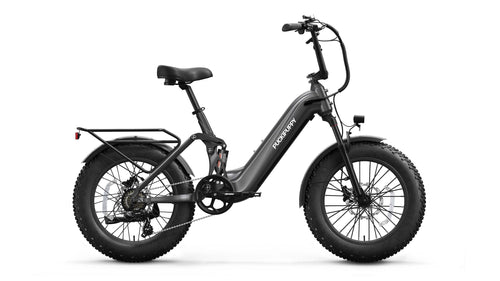
The Puckipuppy Corgi shows how that works in practice. Its 20" × 4" fat tires are paired with a low-step frame and lower center of gravity, reinforcing the easier starts, stops, and low-speed maneuverability that many riders look for in a 20-inch bike. A 100mm adjustable front fork and rear suspension also help when everyday pavement turns into gravel or rougher paths.
Corgi Ebike
Importantly, choosing the smaller wheels does not mean choosing a smaller battery or less useful range. The Corgi has a 48V 20Ah battery, a 750W motor with 960W peak output, and a rated range of 40 to 80 miles. For riders who prefer the compact feel of a 20-inch fat tire e-bike, it still provides the power and range expected from a full-size everyday e-bike.
If this type of ride fits your needs, explore Puckipuppy’s 20-Inch Electric Bikes to compare more models built around compact handling, everyday versatility, and easier storage.
Choose a 26-Inch Fat Tire E-Bike If You:
- Ride longer distances more often
- Spend more time on gravel, rough roads, or uneven trails
- Prefer a more stable, full-size riding feel
- Have enough storage space for a larger bike
- Want smoother rollover across bumps and rough surfaces
With a 26-inch bike, the advantage comes from combining the larger wheel with a setup that supports longer and rougher rides. Larger wheels can roll over uneven surfaces more smoothly, while suspension and braking become increasingly important as speed and terrain vary.
The Puckipuppy Boxer follows that approach with 26" × 4" fat tires, full suspension, and a 130mm adjustable front fork. Compared with the more compact Corgi setup, the Boxer puts more emphasis on stability and smoothing out repeated bumps on gravel roads, uneven paths, and longer recreational routes. Its 180mm hydraulic disc brakes add more controlled braking when the terrain changes.
Boxer
If stability, rollover, and longer mixed-terrain rides matter more, explore Puckipuppy’s 26-Inch Electric Bikes to compare full-size fat tire models designed for a wider range of outdoor riding.
Find the Wheel Size That Fits Your Ride
Choosing between a 20-inch and 26-inch fat tire e-bike is less about finding the “better” wheel size and more about matching the bike to everyday use. A 20-inch setup makes more sense when compact handling, storage, and easy maneuverability come first. A 26-inch setup is usually the stronger fit for riders who value stability, longer rides, and more uneven terrain.
Ready to compare your options? Explore Puckipuppy’s 20-Inch Electric Bikes and 26-Inch Electric Bikes to find the wheel size and setup that best match your riding style.