














Electric mountain bikes are generally better suited to technical trails, steep climbs, sharp turns, exposed roots, and rocky sections where precise handling matters. Fat tire e-bikes are usually a stronger fit for gravel roads, loose sand, shallow snow, broken pavement, and routes that regularly move between paved and unpaved surfaces.
The two categories are often confused because both may include powerful motors, hydraulic disc brakes, front or full suspension, and components associated with off-road riding.
The better choice depends less on peak motor wattage than on the terrain you ride most often, the steering precision you need, and how you plan to use the bike beyond dedicated trails.

What Is the Main Difference Between an Electric Mountain Bike and a Fat Tire E-Bike?
The main difference lies in how each bike is designed for terrain. An electric mountain bike uses trail-focused geometry, narrower tires, and tuned suspension for precise handling, efficient climbing, and controlled descending. A fat tire e-bike uses wider tires and a stability-oriented setup to improve traction and comfort on loose or uneven surfaces.
Both can ride off pavement, but an eMTB is better suited to technical trails requiring quick steering and active control, while a fat tire e-bike is more practical for gravel, sand, shallow snow, rough pavement, and wide forest roads.
What Is an Electric Mountain Bike?
An electric mountain bike, often shortened to eMTB, combines pedal assistance with the frame design and trail-focused components of a mountain bike. Its geometry positions the rider for active body movement, helping with balance, climbing, descending, and quick reactions when crossing roots, rocks, narrow turns, and uneven trail sections.
Electric mountain bikes usually use tires that are narrower than traditional fat tires. This typically improves steering response, rolling efficiency, and control on firm or technical ground. Their suspension systems are designed not only for comfort but also to help the wheels remain connected to the trail through repeated impacts.
What Is a Fat Tire E-Bike?
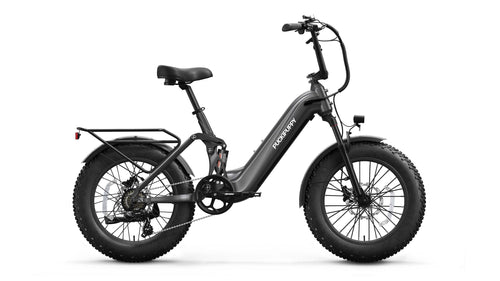
A fat tire e-bike uses wide, high-volume tires, commonly around four inches across, to create a larger contact area with the ground. This design can improve stability and flotation on loose gravel, sand, shallow snow, rough roads, and other surfaces where narrower tires may sink or feel less secure.
Many fat tire e-bikes are designed for broader everyday use rather than specialized mountain riding. Their upright riding positions, stable handling, and compatibility with racks or cargo accessories can make them suitable for commuting, camping, recreational exploration, and routes that combine paved and unpaved sections.
Electric Mountain Bike vs Fat Tire E-Bike at a Glance
|
Comparison |
Electric Mountain Bike |
Fat Tire E-Bike |
|
Primary purpose |
Technical trail riding and precise handling |
Stability, comfort, and mixed-terrain versatility |
|
Best terrain |
Roots, rocks, steep climbs, sharp turns, and narrow trails |
Gravel, sand, shallow snow, forest roads, and broken pavement |
|
Common tire sizes |
Commonly 27.5×2.3 to 29×2.6 inches |
Commonly 20×4 or 26×4 inches |
|
Tire design |
Narrower tires with quicker steering response |
Wider tires with a larger contact area |
|
Handling |
More agile and precise on technical trails |
More stable and forgiving on loose surfaces |
|
Riding position |
Sportier position that supports active body movement |
Usually more upright and relaxed |
|
Suspension focus |
Trail control and consistent wheel contact |
Comfort and stability across rough mixed surfaces |
|
Paved-road efficiency |
Usually more efficient |
Wider tires usually create more rolling resistance |
|
Soft-surface performance |
More likely to sink in deep sand or soft snow |
Wider tires usually provide better flotation and stability |
|
Overall size |
Usually more compact and lighter |
Usually wider and takes up more storage space |
|
Cargo use |
Rarely the main design priority |
Often easier to equip with racks, baskets, and bags |
|
Best suited to |
Riders who prioritize trail handling and performance |
Riders who prioritize comfort, cargo use, and mixed-terrain riding |
Which Bike Is Better for Different Terrain?
Technical Singletrack, Roots, and Rocks
Electric mountain bike: Better for narrow trails, exposed roots, loose rocks, steep transitions, and sharp turns because its responsive steering supports precise wheel placement.
Fat tire e-bike: Suitable for smoother trails and wide forest paths, but its heavier frame and slower steering may feel less agile on tight or obstacle-heavy routes.
Gravel Roads and Forest Roads
Electric mountain bike: Better for steeper, faster, or more technical gravel routes where agile handling improves control through corners and rough descents.
Fat tire e-bike: Better for relaxed gravel riding, camping, and casual exploration because its wider tires provide more stability and comfort on loose stones and uneven tracks.
Sand and Loose Ground
Electric mountain bike: Narrower tires may sink more easily into deep sand or loose ground, making it less suitable for extended riding on soft surfaces.
Fat tire e-bike: Usually performs better because wider tires spread the bike’s weight across a larger area, although sand can still reduce battery range significantly.
Snow and Winter Roads
Electric mountain bike: Can handle firm winter trails, but narrower tires generally provide less flotation on shallow snow and compacted surfaces.
Fat tire e-bike: Usually offers better stability on shallow snow, although riders must still slow down on ice and account for reduced battery range in cold weather.
Paved Roads and Urban Riding
Electric mountain bike: Usually rolls more efficiently on smooth pavement because its narrower tires create less resistance and respond more quickly.
Fat tire e-bike: Often feels more comfortable on cracked streets and potholes, but its heavier and wider design can make storage and transport more difficult.

How Do Tire Width and Frame Geometry Affect the Ride?
Tire Width and Surface Contact
Electric mountain bikes usually use narrower tires that respond more quickly to steering input and roll efficiently on firm trails. Fat tire e-bikes create a larger contact patch, which can improve stability on gravel, sand, shallow snow, and uneven roads.
The trade-off is that wider tires usually create more rolling resistance and steering weight. They can feel forgiving on rough surfaces, but they are generally less agile when riders need to change direction quickly on narrow or obstacle-heavy trails.
Frame Geometry and Riding Position
An eMTB typically uses trail-focused geometry that helps riders shift body weight during climbs, descents, and tight turns. Its more active riding position supports precise control when the terrain requires frequent movement and quick decisions.
Fat tire e-bikes often use a more upright riding position that prioritizes comfort and stability. This can work well for recreational riding and mixed roads, although it may provide less control during steep descents or technical cornering.
20×4 vs 26×4 Fat Tires
A 20×4 fat tire setup usually creates a lower center of gravity and a more compact bicycle, which can help with frequent stops, storage, and low-speed handling. This size is common on folding, utility, and urban-oriented fat tire models.
A 26×4 setup generally rolls over potholes, roots, and uneven ground more smoothly. It may feel better on longer rides and rougher roads, although rider fit still depends on frame size, seat height, reach, and overall geometry.
Suspension and Comfort: What Is the Difference?
Electric mountain bike suspension focuses more on maintaining wheel contact and control over roots, rocks, and repeated impacts, while fat tire e-bike suspension prioritizes comfort and stability across potholes, gravel, and rough mixed surfaces.
Motor Power, Torque, and Climbing Ability
Electric mountain bikes are usually more efficient on steep technical climbs because of their lower weight and trail-focused gearing, while fat tire e-bikes often provide greater stability and traction on loose ground or under heavier loads.
Weight, Storage, and Everyday Practicality
Electric mountain bikes are usually lighter and easier to transport or store, while fat tire e-bikes are generally heavier and wider but often provide better compatibility with racks, baskets, bags, and other cargo accessories.
Who Should Choose an Electric Mountain Bike?
An electric mountain bike is a better choice for riders who regularly encounter steep climbs, rocky sections, uneven trails, sharp turns, and technical descents. It suits riders who value responsive pedal assistance, effective suspension, reliable braking, adaptable gearing, and greater control as trail conditions change.
For example, the PUCKIPUPPY Labrador Pro combines a 1350W peak motor, torque and cadence sensors, a Shimano eight-speed drivetrain, full suspension, a 110mm adjustable front fork, and hydraulic disc brakes. These features support climbing, speed adjustment, impact absorption, and controlled braking across hills, gravel roads, rugged trails, and other changing terrain.
Labrador Pro
Who Should Choose a Fat Tire E-Bike?
A fat tire e-bike is a better choice for riders who regularly travel across gravel roads, broken pavement, wide forest paths, sand, or shallow snow. It suits riders who value stability, comfort, traction, and confidence when moving between paved and unpaved surfaces.
For example, the PUCKIPUPPY Boxer combines 26×4-inch fat tires, a dual-suspension system, a 130mm adjustable front fork, a Shimano seven-speed drivetrain, hydraulic disc brakes, and a 960W peak motor. These features support comfortable riding, stable handling, and controlled braking across pavement, gravel, campground roads, and light forest trails.
Boxer
Quick Terrain-Based Decision Guide
|
Your Main Riding Situation |
Better Choice |
|
Narrow trails with roots, rocks, and sharp turns |
Electric mountain bike |
|
Steep technical climbs and descents |
Electric mountain bike |
|
Wide forest roads and relaxed gravel riding |
Fat tire e-bike |
|
Sand or shallow snow |
Fat tire e-bike |
|
Broken pavement and mixed urban routes |
Fat tire e-bike |
|
Easier transportation and lower weight |
Electric mountain bike |
|
Carrying gear or adding cargo accessories |
Fat tire e-bike |
|
Pavement, gravel, and recreational trails in one ride |
Fat tire e-bike |
Which E-Bike Is Right for Your Terrain?
Electric mountain bikes are better suited to riders who prioritize precise handling, responsive climbing, and control on steep, rocky, or technical trails, while fat tire e-bikes are more practical for gravel, broken pavement, sand, shallow snow, and mixed-terrain riding. The right choice depends on the surfaces you encounter most often, along with your needs for comfort, storage, cargo capacity, and transport. Models such as the PUCKIPUPPY Labrador Pro offer mountain-oriented support for hills and rugged routes, while the Boxer emphasizes fat tire stability, comfort, and everyday versatility.