














For paved commuting, recreational rides, moderate hills, and longer distances, a well-matched single-motor e-bike generally offers the better balance of efficiency, manageable weight, predictable handling, and simpler ownership. A dual-motor e-bike becomes more useful when steep hill starts, heavier loads, and low-traction surfaces such as loose gravel, dirt, or sand are regular parts of the ride.
The important distinction is that a second motor does more than increase combined power. In a typical dual-hub setup, both the front and rear wheels can contribute drive force. That can improve acceleration, climbing support, and forward traction, but it also adds weight, increases electrical demand, and makes the bike more complex to transport and service.
So the real question is not whether two motors are more powerful. It is whether the second driven wheel solves a problem you encounter often enough to justify those trade-offs.
Single-Motor vs Dual-Motor E-Bikes at a Glance
|
Comparison |
Single-Motor E-Bike |
Dual-Motor E-Bike |
|
Power Delivery |
One motor delivers power through a single driven wheel |
Front and rear motors can share propulsion demand |
|
Hill Climbing |
Well suited to moderate hills with proper gearing and rider input |
Better for repeated steep climbs and loaded hill starts |
|
Traction |
Sufficient on firm pavement and predictable surfaces |
Better forward traction on loose gravel, dirt, sand, and similar terrain |
|
Range |
Generally more efficient during steady riding |
Higher energy use when both motors operate at strong output |
|
Weight & Handling |
Lighter, easier to maneuver, transport, and control at low speed |
Heavier, with additional front-wheel weight affecting steering feel |
|
Maintenance |
Simpler electrical system with fewer service points |
More motors, controllers, wiring, and components to maintain |
For most daily riders, a single motor offers a better balance of efficiency, weight, and simplicity. Dual motors become more useful when steep climbs, heavier loads, or low-traction terrain are regular parts of the route.
What Do Single-Motor and Dual-Motor Actually Mean?
A single-motor e-bike uses one electric drive unit. Depending on the bike, that motor may be located in the front hub, rear hub, or at the crank. Rear-hub motors are especially common on commuter, fat-tire, folding, and recreational e-bikes.
In a single-hub system, motor-driven propulsion reaches the ground through one tire.
A typical dual-motor e-bike places one hub motor in the front wheel and another in the rear. When both are engaged, both wheels can contribute propulsion. Some models allow riders to switch between single- and dual-motor operation, while others manage the motors through preset riding modes.
Dual motors should not automatically be confused with the sophisticated all-wheel-drive systems used in cars. Many dual-motor e-bikes do not continuously detect wheel slip and redistribute torque in real time. Their behavior depends on motor output, controller programming, throttle or pedal-assist input, battery performance, and how smoothly the front motor engages.
This is why motor count alone cannot tell you how an e-bike will perform. A well-integrated single-motor bike can feel smoother and more practical than a poorly tuned dual-motor model, while a properly designed dual-motor system can provide a real advantage when climbing, load, or traction demands increase.

What Does the Second Motor Actually Change?
The most important change is where the drive force reaches the ground.
With a single rear motor, one tire handles all motor-driven propulsion. With front and rear motors working together, both wheels can contribute to moving the bike forward.
That becomes useful during steep restarts, under heavier loads, or when one tire begins to lose grip on loose terrain. Instead of relying on one motor and one driven wheel, a dual-motor system can distribute the propulsion demand between both wheels.
This does not eliminate wheelspin or overheating. Tire grip still limits how much power can reach the ground, while the battery and controllers must be capable of supporting the combined motor demand.
For riders who mainly travel on firm pavement and moderate terrain, the second motor may rarely be necessary. Its value becomes much clearer when difficult starts, loose climbs, or heavier loads are recurring parts of the ride.
Power and Hill Climbing: Is Dual Motor Always Better?
Dual motors generally provide stronger hill starts and more support under load, but they are not necessary for every incline. Hill grade, climb length, surface conditions, rider weight, cargo, gearing, battery output, and pedaling effort all influence real-world climbing performance.
Use Hill Grade as a Practical Reference
Most navigation and cycling apps express hills as a percentage grade. These ranges provide a useful way to understand how demanding a route may be, but they should not be treated as guaranteed climbing limits for every e-bike.
|
Hill Grade |
What It Usually Feels Like |
Motor Consideration |
|
Below 5% |
Gentle incline |
A capable single motor is generally sufficient |
|
5%–8% |
Noticeable everyday climb |
Single motor is generally adequate under normal loads |
|
8%–12% |
Demanding, especially with extra weight |
Torque, gearing, load, and rider input become more important |
|
12%–15% |
Steep enough to make low-speed climbing or restarting difficult |
Dual motors may offer a clear advantage under load |
|
Above 15% |
Very demanding for sustained riding |
Traction, heat, battery output, total load, and system limits all matter |
A lightly loaded e-bike may handle a short, steep paved section well, while a longer and less steep gravel climb with a heavier rider can place greater sustained demand on the motor. The percentage alone does not determine which motor system you need.
Hill Starts Matter More Than Many Buyers Expect
Maintaining momentum and restarting from a stop are different challenges.
Once an e-bike is moving, momentum and rider pedaling help it continue uphill. Stop halfway at an intersection, gate, trail obstacle, or steep driveway, and the motor has to accelerate the full bike-and-rider load again from very low speed.
This is one of the situations where dual motors can provide a noticeable advantage. Having both wheels contribute drive force can make steep restarts easier, especially when cargo or loose terrain adds to the demand.
Compare the Complete System, Not Only Wattage
A larger wattage figure does not guarantee better climbing.
A well-tuned 750W single-motor bike with suitable gearing, sufficient battery output, and good tire grip can be more usable than a dual-motor system that delivers power abruptly or cannot sustain its advertised peak output.
Peak power is especially useful during short demands such as acceleration and hill starts. It should not be treated as the power a bike can necessarily maintain throughout a long climb.
When Dual Motors Provide a Real Advantage
Dual motors make the most sense when demanding climbing conditions are part of normal riding. This includes repeated steep climbs, heavy-load hill starts, long climbs where speed falls significantly, and loose uphill surfaces where one driven wheel frequently loses traction.
Extended maximum-output riding can still increase battery consumption and motor heat, so a second motor does not remove the need for appropriate gearing, tire grip, and sensible power use.
When a Single Motor Is the Better Choice
A single motor remains the more practical option when most climbs are moderate, steeper sections are short or infrequent, the road surface is firm and predictable, cargo loads are manageable, and lower bike weight or longer range matters more than maximum climbing support.
For everyday commuting and recreational riding, a properly matched single-motor e-bike can handle a wide range of normal hills without adding the weight and complexity of a second motor.

Traction and Handling: Single Motor vs Dual Motor
Traction depends on more than motor power. Tire grip, road surface, weight distribution, and the way torque is delivered all influence how effectively an e-bike puts power to the ground.
On dry pavement, a capable single-motor e-bike generally provides enough traction for commuting, recreational riding, and moderate hills. A rear-hub motor also keeps the front wheel free of motor weight and drive torque, which usually makes low-speed steering and tight maneuvers feel more natural.
Dual motors can provide stronger acceleration from a stop, but their traction advantage becomes much more useful when the surface is loose or uneven.
|
Riding Surface |
Single Motor |
Dual Motor |
|
Dry pavement |
Predictable and sufficient for most riders |
Stronger acceleration, but limited extra traction benefit |
|
Moderate gravel |
Capable with suitable tires and controlled assistance |
More support if the driven tire begins to slip |
|
Loose uphill gravel |
May lose momentum when one driven tire spins |
Both wheels can help maintain forward movement |
|
Sand or shallow snow |
More dependent on momentum and tire pressure |
Better chance of maintaining controlled forward motion |
|
Wet grass or dirt |
Requires smooth power input |
More available traction, although wheelspin can still occur |
|
Tight uneven terrain |
Lighter front end can make direction changes easier |
Extra drive helps on climbs, but steering may feel heavier |
On loose surfaces, a single-motor bike depends on one driven tire to transfer power. If that tire starts to spin, forward momentum can drop even when the motor still has power available. A dual-motor system gives the second wheel a chance to keep the bike moving, which is especially useful on loose climbs or under heavier loads.
Two motors still cannot create grip where the tires have none. Tire tread, tire pressure, rider position, and smooth power delivery continue to determine how effectively motor output becomes usable traction.
Handling is another important trade-off. A front hub motor adds both weight and drive torque to the wheel responsible for steering. This can help on a straight loose-surface climb, but it may make tight turns and low-speed maneuvering feel heavier. If front-motor torque engages abruptly while the handlebar is turned, particularly on gravel, sand, mud, or wet pavement, the front tire may slide or the bike may run wider than expected.
Dual motors also do not automatically improve braking. They increase forward traction, while stopping performance still depends on tire grip, brake performance, speed, total bike-and-rider weight, road conditions, and braking technique.
For riders who spend most of their time on firm, predictable roads, a single motor generally provides sufficient traction with easier handling. Dual motors become more valuable when loose surfaces, steep climbs, or heavier loads regularly push one driven tire close to its traction limit.
Range and Battery Use: Does Dual Motor Drain the Battery Faster?
Dual motors do not automatically cut range in half, but using both motors at high output generally consumes more energy than steady single-motor riding. Hard acceleration, long climbs, higher speeds, and heavier loads all increase battery demand.
Battery capacity is best compared in watt-hours:
Watt-hours = Voltage × Amp-hours
For example, a 48V 20Ah battery stores 960Wh of nominal energy. A larger battery can help offset the greater demand of a dual-motor system, which is why advertised range should not be compared by motor count alone.
On bikes with selectable drive modes, a practical approach is to use one motor for flat roads and steady cruising, then engage both motors for steep starts, heavier loads, or loose climbs.
A single-motor e-bike is generally the better choice when maximum range and efficiency matter most. A dual-motor bike makes more sense when the rider is willing to trade some efficiency for stronger climbing support and traction when conditions demand it.
Which One Should You Choose?
The best choice depends on the conditions you ride most often—not the most extreme terrain you might encounter occasionally.
Choose a Single-Motor E-Bike If
A single motor is usually the better fit if you mainly ride on paved roads, encounter moderate or occasional hills, prioritize range and manageable weight, or frequently transport the bike.
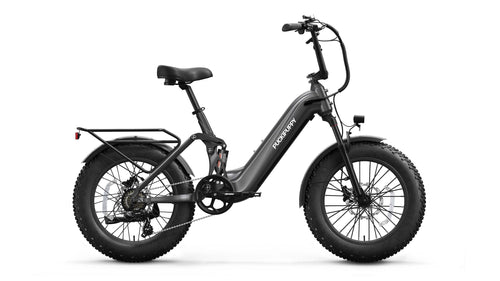
A single motor does not limit you to city streets. The PUCKIPUPPY Boxer, for example, combines a 750W rear motor with up to 960W peak output, a 48V 20Ah battery, 26 × 4-inch fat tires, full suspension, and hydraulic disc brakes. This type of setup can handle pavement, gravel, campground roads, and other mixed surfaces without requiring a powered front wheel.
The important point is to evaluate the entire bike rather than judging its capability by motor count alone.
Boxer ebike
Choose a Dual-Motor E-Bike If
Dual motors are more useful when a steep hill starts, heavier loads, and loose surfaces are regular parts of the ride. They are especially valuable when one driven wheel frequently struggles to maintain traction on gravel, dirt, sand, or uneven climbs.
The PUCKIPUPPY GoldenR Pro illustrates this type of use. Its front and rear motors provide 1,100W of combined rated output and up to 1,600W of combined peak output, while the 48V 20Ah battery, 26 × 4-inch fat tires, full suspension, and selectable single- or dual-motor operation allow riders to reserve both motors for terrain that actually requires the extra drive force.
The key buying rule is simple: choose a second motor when it solves a climbing, traction, or load problem that appears regularly on your routes—not simply because the combined wattage is higher.
GoldenR Pro
Single Motor or Dual Motor?
For most everyday riders, a capable single-motor e-bike offers the better balance of range, weight, handling, and maintenance. It is well suited to commuting, recreational riding, moderate hills, and mixed routes where extreme traction is not a regular requirement.
Dual motors are worth considering when steep starts, heavier loads, or loose terrain are part of normal riding. In those situations, distributing drive force between both wheels can provide a meaningful advantage in climbing and maintaining forward momentum.
The right choice is not the motor system built for the most extreme situation you might encounter once a year. It is the one that best matches the roads, hills, loads, and surfaces you ride most often.
Explore PUCKIPUPPY electric bikes and compare single and dual-motor options to find the setup that best matches your everyday routes and outdoor riding needs.