














In states that use the common three-class e-bike system, motor assistance generally cuts off at 20 mph or 28 mph, depending on the class. Class 1 and Class 2 e-bikes are generally assisted up to 20 mph, while Class 3 e-bikes can provide pedal assistance up to 28 mph. These figures refer to the motor-assistance cutoff, not the bicycle’s absolute maximum speed. A rider may still travel faster by pedaling or descending, but under the three-class system, motor assistance must stop at the applicable class limit.
A bike rated for 28 mph may get close to that speed on a flat, open road with a well-charged battery, but the same bike can be noticeably slower when climbing, riding into a headwind, carrying extra weight, or crossing loose terrain.
To understand how fast an e-bike will actually feel in everyday riding, you need to look at the complete drive system and the conditions in which the bike will be used.

How Fast Do Electric Bikes Usually Go?
For most riders, the useful speed range of an e-bike is easier to understand through its assisted-speed class than through motor wattage alone.
|
E-Bike Class |
Motor Assistance |
Common Assisted Speed |
|
Pedal assist |
Up to 20 mph |
|
|
Throttle-assisted; may also provide pedal assist |
Up to 20 mph |
|
|
Class 3 |
Pedal assist |
Up to 28 mph |
Under the three-class framework, these numbers describe the point at which motor assistance is required to stop. Reaching that cutoff does not necessarily mean the bicycle itself becomes incapable of traveling faster; rider pedaling or a downhill grade may still increase speed after motor assistance ends.
Legally, the 20 mph and 28 mph figures should not be treated as universal road speed limits. They are used to classify e-bikes, while where a particular class may be ridden can still depend on state and local rules.
Federal consumer-product law uses a separate definition for a low-speed electric bicycle. Under 15 U.S.C. § 2085. it is a two- or three-wheeled vehicle with fully operable pedals, an electric motor of less than 750W, and a maximum speed of less than 20 mph when powered solely by the motor on a paved, level surface with a 170-pound rider. This federal definition concerns how a low-speed electric bicycle is treated as a consumer product and is separate from state Class 1. Class 2. and Class 3 operating rules.
The practical point is that an e-bike's 20 mph or 28 mph assisted-speed rating helps describe its classification, but it does not by itself determine where that bike may legally be ridden.
Related Reading: Your 2026 Guide to Electric Bike Laws
Advertised Top Speed vs. Real Riding Speed
An advertised top speed usually refers to the highest speed at which the motor is designed to continue providing assistance under suitable conditions. It should not be read as a guaranteed cruising speed or as proof that the bike will reach that speed equally quickly under every load and road condition.
Consider a 28 mph e-bike. On level pavement, with a high battery state of charge, proper tire pressure, and normal rider input, the bike may approach its rated assisted speed. Put the same bike on a sustained climb or add a heavier rider and cargo, and more of the available motor output is needed simply to overcome gravity and rolling resistance. The bike may still accelerate normally at lower speeds but struggle to reach or maintain the final few miles per hour.

This distinction matters because reaching 28 mph and holding 28 mph are different performance questions. Once speed rises, aerodynamic resistance increases sharply, so maintaining a higher cruising speed requires progressively more power. A bike with stronger peak output or more power reserve may reach its assisted-speed ceiling faster and lose less speed under load, even if another bike carries the same 28 mph rating.
The assistance cutoff is also not necessarily the bicycle's physical maximum speed. Once motor assistance tapers off or stops at the programmed limit, rider pedaling or a downhill grade can still carry the bike faster. What the specification tells you is primarily the motor-assisted speed ceiling.
For real-world comparison, top speed therefore tells only part of the story. Acceleration, the ability to hold speed under load, and how much performance remains on hills are often more useful indicators than the advertised mph figure alone.
What Actually Determines E-Bike Speed?
Motor wattage alone does not determine how fast an e-bike will feel. Real performance comes from the motor, controller, battery voltage, total load, and riding conditions working together.
A higher-rated or higher-peak-output motor can improve acceleration and help the bike hold speed on hills or under heavier loads, but it does not automatically mean a higher top speed. The controller and software may still limit motor assistance to 20 or 28 mph, which is why two 750W e-bikes can have very different acceleration and climbing performance even when their assisted-speed limits are the same.
Battery voltage also affects how the drive system delivers power, while battery capacity mainly affects how long that power can be sustained. A larger Ah or Wh figure does not by itself make an e-bike faster.
Real-world speed then depends on what the bike has to overcome. A heavier rider, added cargo, steep grades, headwinds, soft surfaces, or underinflated tires all increase resistance and can reduce acceleration or climbing speed. For practical comparison, look beyond wattage and consider how the complete system performs under the load and terrain you actually ride.

Does Riding Faster Reduce E-Bike Range?
Yes. Holding a higher speed generally uses more energy, especially once aerodynamic drag becomes a larger part of the resistance the motor has to overcome.
Riding near the highest assist level, accelerating hard after frequent stops, or trying to maintain 28 mph for long periods will usually drain the battery faster than riding at a moderate, steady pace. The difference becomes even more noticeable on longer routes.
For riders who care about range, the practical approach is simple: use higher assistance when you need it, but avoid treating maximum assisted speed as the default cruising speed for the entire ride.
How Much E-Bike Speed Do You Actually Need?
For short commutes, neighborhood riding, and recreational use, assisted speeds around 20 mph are often enough. Riders covering longer road-based routes may benefit more from assistance up to 28 mph, especially when they need to maintain pace over greater distances.
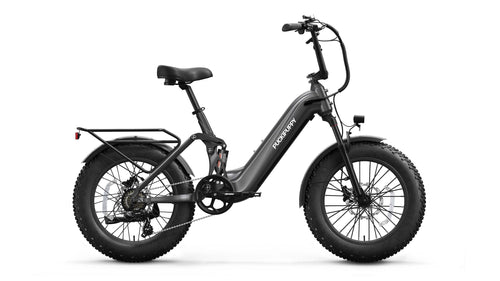
For example, the PUCKIPUPPY Boxer provides throttle assistance up to 20 mph and pedal assistance up to 28 mph. That makes the higher assisted speed useful when riding longer stretches of open road, while its full suspension and hydraulic disc brakes also make it better suited to riders who move between pavement and rougher surfaces. In this case, the 28 mph rating is useful because it is supported by features designed for the conditions in which that speed may actually be used—not simply because the number itself is higher.
Cargo and off-road riders usually have different priorities. When carrying a heavier load or passenger, riders should reduce speed before intersections, turns, and descents because the added mass affects acceleration, handling, and the distance needed to slow the bike.
Off road, speed should be adjusted to the available traction and sight distance. Firm gravel may allow a steady pace, while loose gravel, roots, ruts, blind corners, and technical sections require earlier braking and lower entry speeds. In these conditions, maintaining control is more important than trying to use the bike's full 20–28 mph assisted-speed capability.
In both cases, 20–28 mph may be available from the bike, but it is rarely the speed that matters most once the bike is heavily loaded or the surface becomes loose and uneven.
Boxer
Choosing the Right E-Bike Speed for Your Ride
The right e-bike speed depends on where you ride and how much of that speed you can realistically use. A higher assisted speed can be valuable for longer road-based trips, while riders carrying cargo or spending more time off pavement may benefit more from predictable power, braking control, and stability.
Instead of choosing an e-bike by top speed alone, look for a bike that delivers the speed you need together with the range, control, and performance required for your normal routes.
Explore PUCKIPUPPY fast electric bikes to compare models built for different riding speeds and everyday needs.